Throughout my time on the Internet, I’ve made numerous attempts at blogs, some ranging from simple online journals to others where I’ve essentially just ‘reblogged’ whatever it was that I found interesting at the time.
I think it’s generally fair to say, with the benefit of hindsight, that airing my dirty laundry, insecurities, and perhaps frustrations with unrequited feelings wasn’t the wisest of decisions on a medium that essentially never forgets. When your professional reputation, whatever the hell that means, could potentially come under fire because you found something controversial interesting or posted a less-than-savoury opinion on a topic fifteen years ago, it can sometimes feel like the best option is simply not to post at all.
On the other hand, I have such an admiration for those who post so much without fear of reprisal; posting purely for the sake of loving writing and sharing their opinions and thoughts with the world, not because they’re trying to manipulate search engines or grift some ad revenue from whatever happens to be popular that week. Pure and simple posting for the love of the game. Take my Three Rings colleague Dan Q, whose blog spans multiple decades across countless topics. I’m sure he would shy away from such an accolade, but I think it’s truly a fantastic example of using the Internet as it was intended: having your own little corner of it and filling it with the things that interest you, regardless of whether anybody else particularly cares.
I think over the years one of the biggest things holding me back from writing has been perfectionism. This problem was definitely more apparent when I was publishing on Hashnode, since every post was immediately up for consumption by other developers on the platform, but now that this platform is completely my own, for hundreds of readers or just me, I can post whatever I want. Nevertheless, I’ve always felt the need to meticulously refine every piece of writing as though I were writing an essay. There has to be a point, some kind of useful conclusion, and enough meat on the bones to justify publishing the thing in the first place. If I only have a few paragraphs to say about something, does it really warrant an entire blog post? If somebody else has already written about it, what exactly am I adding? If it’s technical, am I absolutely certain that everything I’ve written is correct? Eventually you place so many conditions on something being worthy of a blog post that it becomes much easier to not write one.
There’s also nowadays the temptation to rewrite my thoughts and feelings in robotic, algorithmically generated prose until every sentence has been perfectly sanded down. It’s very easy to end up with something technically well-written that nevertheless doesn’t sound much like the person supposedly writing it. The irony isn’t lost on me after having ChatGPT at least proofread this post.
Therein lies another irony, though. I’m already constantly blogging. I’m just constantly blogging into ChatGPT. Perhaps OpenAI should pay me instead?
A train of thought, a bug I encountered, some old piece of technology I remembered and wanted to explore in more detail, something somebody said, a strange question that popped into my head while doing something completely unrelated. I already spend an absurd amount of time catching myself thinking “huh, that’s pretty interesting” and digging further into it. Perhaps these aren’t distractions from ‘real’ topics at all. Maybe the people who have managed to keep their blogs going for decades aren’t walking around with an endless supply of profound observations that the rest of us somehow lack; they’re simply better at noticing the little things they find interesting and, obviously, considering those things worth writing down.
There’s nothing wrong with exploring them privately with ChatGPT, of course, but why not share some of my findings and feelings with the world? Why shouldn’t I let my soul spill onto the digital page? Not everything needs to be a definitive essay on the subject, either. If something warrants 2,000 words, great. If I’ve exhausted everything I wanted to say after 300, I somehow don’t think I’m going to be penalised for it. Of course, I would never let ChatGPT write for me… let alone think for me. I’m perfectly content using it as a learning and revision tool, and taking anything it regurgitates with a pinch of salt. After all, man and machine alike are very good at spinning a good yarn. But that doesn’t mean it can’t be useful in my experiment.
Enter, the worksheet.
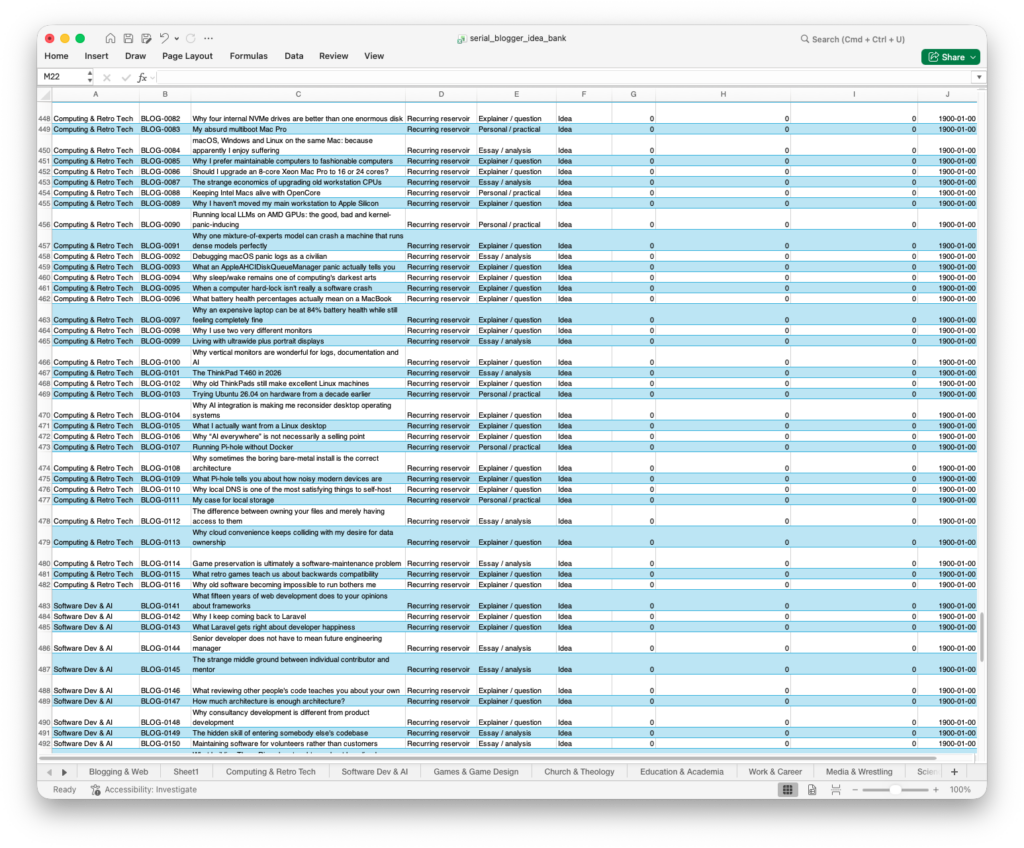
I tasked ChatGPT to carefully and methodically go through its memory and piece together every single topic we’ve ever discussed; everything that could potentially make an interesting piece of writing to zero or more people. Then, based on its findings, amalgamate them all into an Excel workbook, dividing them into topical worksheets.
What surprised me wasn’t necessarily how many ideas it came up with, but how many of them were things I’d already spent quite a lot of time thinking or talking about. The spreadsheet hadn’t really generated hundreds of topics for me at all. They were already there. I’d just never considered most of them substantial enough, or generally ‘bloggy’ enough to actually write about. This doesn’t mean I’ve now saddled myself with a colossal backlog that I am duty-bound to complete; some of those ideas will probably sit in the workbook untouched for years. Some will become long articles, some might end up being little more than a few paragraphs, and I imagine plenty will eventually make me wonder what on Earth I found so interesting about them in the first place.
But that’s fine. An idea written down isn’t a contractual obligation to do anything with it. I’m aiming to work my way through this lengthy workbook, starting with this very topic. The one it suggested that I should start with. Why post at all? Maybe, just maybe, I’ll have a fun archive of things by the end. Perhaps other people will occasionally stumble across something useful, interesting, funny, or sufficiently obscure that I’m the only result left when they desperately Google it ten years from now. This of course is a side effect, not the goal.
As for the question I started with – how do people blog for thirty years without running out of things to say? I think I was approaching it from the wrong direction. Nobody sits down with thirty years’ worth of material ready to go. They just keep finding things interesting for thirty years.
And if I can stop deciding that half of those things aren’t important enough to write about, maybe I can just keep writing until my fingers fall off.


Leave a Reply